

Shutters, Awnings, Solar Films: Which Protection to Choose for Your Apartment?

In summer, heat enters mainly through the windows. A sun-exposed window can let up to 80% of solar radiation through as heat into your apartment. To effectively fight overheating, you need to block this radiation — and preferably before it reaches the glass. Here is an overview of the solutions available for a Parisian apartment, with their specific co-ownership constraints.
Why Block the Sun Before It Reaches the Glass?
This is the fundamental principle of sun protection: an exterior protection is always more effective than an interior one, because it prevents heat from entering the home before it has passed through the glass.
A window in direct sunlight heats the air nearby considerably. If you use a curtain or interior blind, the radiation has already passed through the glass and warmed the air between the window and the blind — this hot air then spreads into the room. Conversely, a shutter or exterior blind intercepts the radiation before it reaches the glass: thermal effectiveness is two to three times higher.
The Solar Factor: The Key Indicator
The solar factor (Fs) measures the proportion of solar energy that passes through a glazed surface and its shading device, from 0 (no transmission) to 1 (total transmission). A standard double glazing has an Fs of approximately 0.6. With an interior blind, it drops to 0.4–0.5. With an exterior blind or shutter, it can reach 0.1–0.2 — meaning four to five times less heat entering.
Exterior Protection: The Most Effective
Roller Shutters
The roller shutter is the most common sun protection in France. When fully closed, it reduces the solar factor to 0.1–0.2. It also provides acoustic insulation (partial soundproofing) and security benefits.
Co-ownership constraint: in apartment buildings, the colour and type of shutter are often defined by the co-ownership rules or an architectural specifications document. In protected areas (Le Marais, historic Île-de-France…), a prior declaration to the town hall may be required.
Retractable Awnings and Projection Blinds
The retractable awning (horizontal projection blind) is particularly suited to balconies and south-facing windows. It blocks direct radiation while letting in diffuse skylight. A vertical projection blind is better suited to east and west facades.
Co-ownership constraint: awnings change the exterior appearance of the building and generally require authorisation from the general assembly, or even a works declaration to the town hall. The fabric must often match a colour defined in the specifications.
Brise-Soleil and Canopies
Brise-soleil (fixed or adjustable horizontal slats) are a permanent architectural solution, often integrated during major renovations. Highly effective on south-facing facades, they block the summer sun (high angle) while letting in winter sun (low angle). They are generally not installed in co-ownerships without an AGM decision and works integrated into a facade renovation.
Interior Protection: Less Effective, But Accessible
Solar Films on Existing Windows
A solar film applied to the inside of an existing window can reduce solar gain by 30 to 60% without major works. This is a particularly attractive solution for apartments in protected areas where exterior shutters are impossible.
Two types:
– Reflective films: reflect solar radiation outward — the most effective in summer, but they can slightly darken the room and limit the view outward (mirror effect on the sun side)
– Tinted/absorbing films: absorb part of the radiation but still release some heat through emission toward the interior — less effective thermally
Caution: applying a reflective film on double glazing can create thermal stress in the glass and cause cracking. Check compatibility with your glazing before installation.
Interior Blinds and Thermal Curtains
Screen blinds, roller blinds, louvred blinds, and curtains with thermal fabric (reflective lining) provide a moderate gain (Fs of 0.4 to 0.5 depending on the product). However, they are easy to install without authorisation and do not change the exterior appearance of the building.
To maximise their effectiveness: close them early (before the glass gets hot) and choose light colours on the window side to reflect rather than absorb.
Specific Constraints in Parisian Co-Ownerships
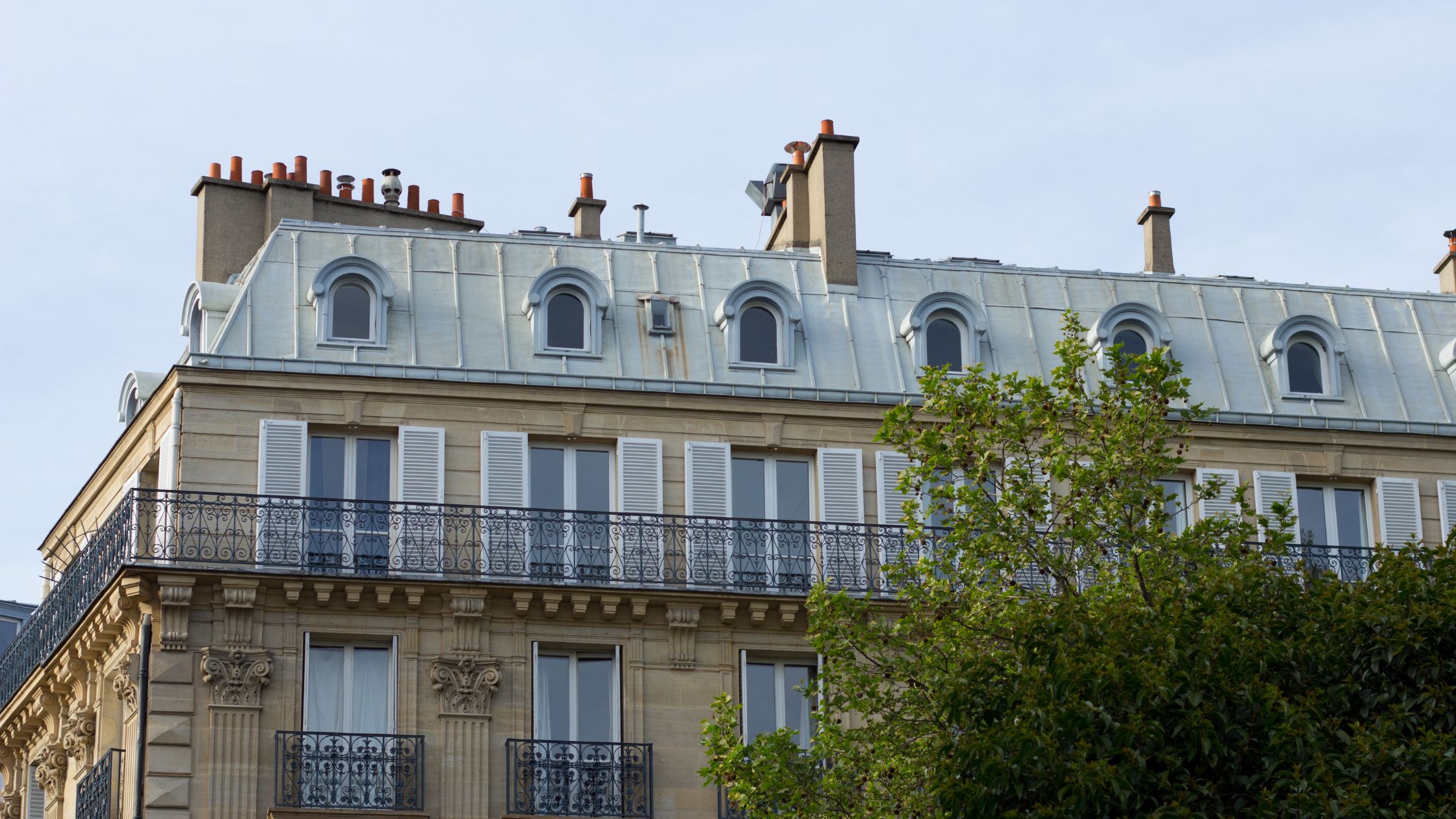
Paris has many protected areas (conservation area, ABF, Local Urban Plan) where facade modifications are regulated. Some practical rules:
– Any addition of sun protection visible from the street (shutter, awning, brise-soleil) must be compatible with the general appearance of the building as defined in the co-ownership rules
– In conservation areas or within ABF perimeters, a prior works declaration is often mandatory even for a simple awning
– The co-ownership general assembly can impose specific colours, materials, or models to ensure facade harmony
– A tenant can generally install interior protections without the landlord's agreement; exterior protections require their agreement and that of the co-ownership
Effectiveness vs Cost: What to Choose?
| Solution | Summer effectiveness | Ease of installation | Co-ownership constraint |
|---|---|---|---|
| Exterior roller shutter | ★★★★★ | Professional works | Yes (colour, model) |
| Exterior awning | ★★★★ | Professional works | Yes (colour, authorisation) |
| Reflective solar film | ★★★ | Very easy | No (interior) |
| Interior screen blind | ★★ | Very easy | No |
| Thermal curtain | ★ | Very easy | No |
The best strategy in a Parisian apartment: combine exterior protection (shutter or awning, if possible) with a solar film on windows that lack shutters. The two complement each other and cover situations where a single solution is not enough.
Réseau Tubulure can guide you toward solutions compatible with your building and provides air conditioning installation when passive measures are no longer sufficient. Contact us for a free quote.
Frequently Asked Questions
Is a solar film on the window really effective?
Yes, provided you choose a reflective film (which bounces radiation outward) rather than an absorbing one. A good reflective film can reduce solar gain by 40 to 60%. It is an accessible and reversible solution, particularly suited to apartments where exterior protections are impossible. However, check compatibility with existing double glazing.
Can I install an exterior awning in a co-ownership without authorisation?
In the vast majority of Parisian co-ownerships, no. Exterior awnings change the facade appearance, which is a common part. Their installation generally requires authorisation from the general assembly and must comply with the co-ownership rules (colour, model, dimensions). In protected areas or within ABF perimeters, a prior declaration to the town hall is also required. Check with your property manager before purchasing.
Roller shutter or awning for a south-facing window?
Both are effective, but they serve different purposes. A roller shutter closes completely: it blocks all light and heat entry but also removes the view and natural light. An awning lets diffuse skylight through while blocking direct radiation — ideal if you want to stay in the room during the day. For a bedroom window where you sleep during the day: roller shutter. For a living room or office: awning or projection blind.
Contact Réseau Tubulure
Need a plumber or air conditioning specialist in Paris? Réseau Tubulure responds quickly throughout Paris and Île-de-France.