

Boiler pressure: too low, too high and how to adjust it

On most wall-hung boilers, normal heating circuit pressure, read cold, is between 1 and 1.5 bar; some manuals allow up to 2 bar. Below about 0.5 bar, the boiler warns you and then stops. At around 3 bar, the pressure relief valve opens. The figure in your own boiler's manual is the one that counts.
Pressure that keeps dropping or a relief valve that drips: our heating engineers in Paris find the cause and fix it.
What is the right pressure? What two manuals say
Figures online vary because each manufacturer sets its own. Here is what two official manuals state:
- Saunier Duval ThemaPlus Condens (a wall-hung condensing boiler common in flats): recommended fill pressure 1 to 1.5 bar, warning at 0.5 bar, shutdown with code F22 at 0.3 bar, maximum heating circuit pressure 3 bar.
- Vaillant ecoTEC plus (manual for the 80 to 120 kW models): fill pressure between 1 and 2 bar, low-water signal below 1 bar, shutdown below 0.5 bar.
Both manuals add the same point: if the system serves several floors, it may need a higher pressure so that air does not get in at the top of the circuit. That applies to a duplex, or to a radiator in a former maid's room (chambre de bonne) fed from the boiler on the floor below.
Always read the pressure cold, with the boiler off for half an hour. When it heats up, the water expands and the needle rises a little: that is normal as long as it stays well below 3 bar.
Pressure too low: top up, then find the cause
With the boiler cold, open the filling loop slowly, watch the gauge, close it fully at the manual's value, then restart. The full step-by-step is in our guide on what to do when the heating fails.
Falling pressure always has a reason:
- A recent bleed: bleeding a radiator lets water out. One top-up is enough.
- A small leak at a fitting, a radiator or a pipe in the wall (see leaking boiler). If nothing is visible, leak detection avoids opening walls at random.
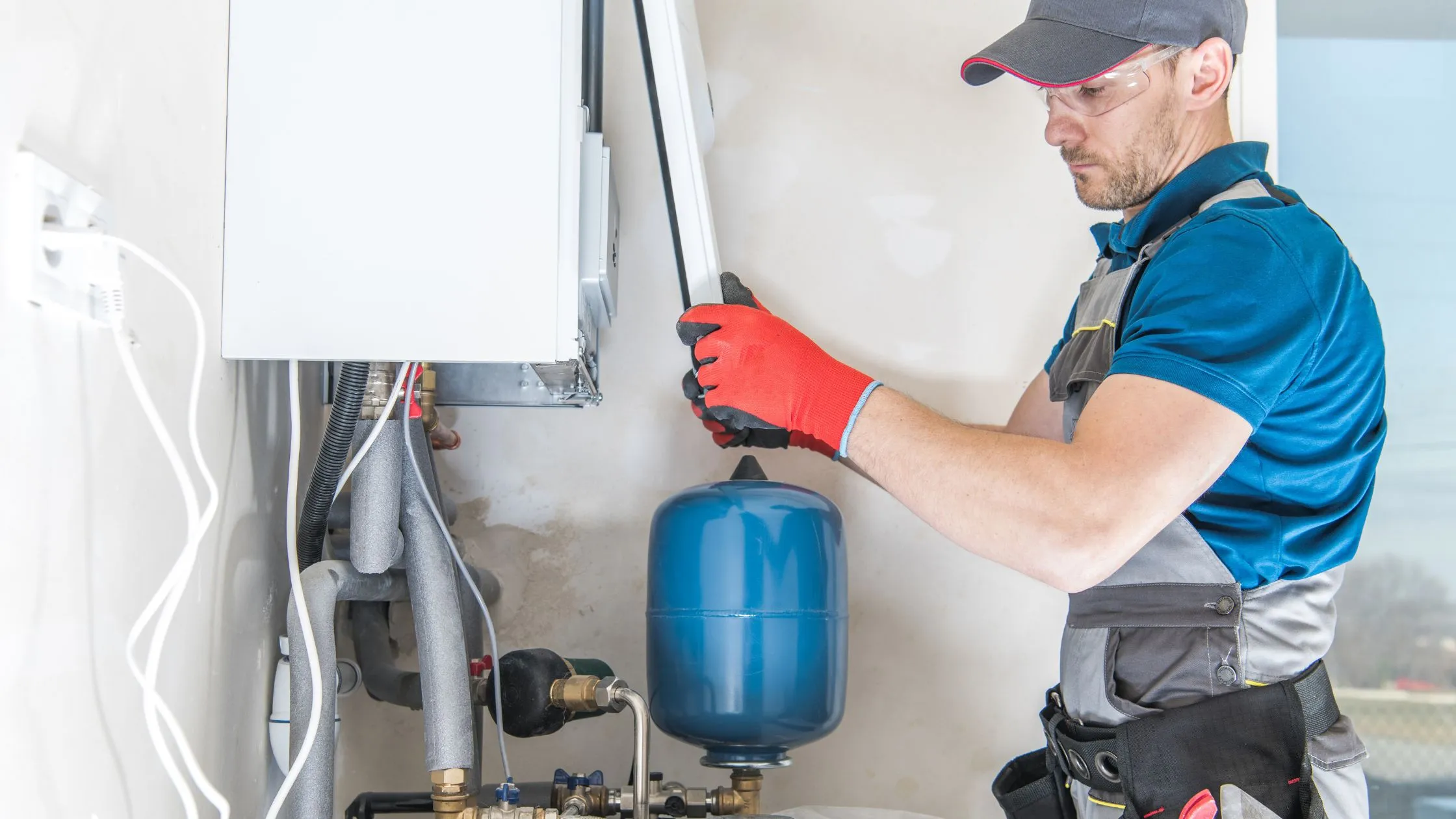
- A flat expansion vessel. This tank absorbs the water's expansion with a cushion of air. Saunier Duval charges it to 0.75 bar, and Vaillant asks for the system pressure to be at least 0.2 bar above the vessel's. When the vessel loses its air, the pressure drops cold and climbs hot.
- A dripping relief valve, which lets water out every time the system heats up.
Topping up too often does harm. Each top-up brings in fresh water, full of limescale and oxygen, which scales and corrodes the circuit. The Saunier Duval manual calls for water treatment once total top-ups exceed three times the system volume.
Pressure too high: 2.5 or 3 bar
Pressure climbing towards 3 bar almost always comes from one of these:
- The filling loop was left slightly open, or its seal no longer closes.
- The circuit was overfilled when cold: there is no margin left for expansion, and the pressure overshoots once it heats up.
- The expansion vessel has no air left and cannot absorb the expansion.
- The domestic hot water heat exchanger is holed: mains water, at higher pressure, passes into the heating circuit.
To bring the pressure down, let the boiler cool, hold a container under a radiator's bleed screw and open it gently until you are back in the manual's range. Close it. If the pressure climbs again over the next days, the cause is mechanical and needs repairing.
Is 3 bar dangerous?
This is what the relief valve is for: it opens and releases the excess. The immediate risk is mostly water on the floor. A valve that opens often ends up leaking all the time, though, and the boiler then runs short of water. Fix the cause rather than draining the circuit every week.
The filling loop: where it is and how it works
It connects the cold water supply to the heating circuit. Depending on the model, it is a quarter-turn valve under the boiler, two valves to open together, or a flexible hose with a valve at each end. The Saunier Duval manual also calls for a backflow preventer (disconnecteur) at this point: it stops heating water, which has sat in the radiators, from flowing back into the drinking water.
A worn filling loop is easy to spot: with the boiler off and cold, the pressure creeps up from one day to the next. It is replaced by isolating the water supply, without changing the boiler.
Boiler "groupe de sécurité": what does it mean?
French speakers use this term for three different parts, so it helps to know which one you have:
- The heating relief valve, on the radiator circuit, which opens at around 3 bar on many wall-hung boilers. If it drips, the circuit pressure is too high.
- The domestic hot water relief valve, found on boilers with a small built-in tank, such as the ThemaPlus Condens. It protects the hot water side.
- The safety group (groupe de sécurité) itself, fitted on the cold inlet of a boiler with a hot water cylinder or of a water heater. It lets a little water out while the tank heats, which is normal in small amounts. Our article on a dripping safety group covers this case.
What not to do
- Top up while the boiler is hot: the reading is wrong.
- Leave the filling loop slightly open.
- Block the relief valve or its drain pipe.
- Pump up the expansion vessel with a bike pump without depressurising the circuit: the reading only means something with the circuit drained, and it is a job for a heating engineer.
When to call a heating engineer
- You top up several times a month.
- The pressure climbs towards 3 bar and the relief valve drips.
- The pressure rises while the boiler is off.
- The needle swings widely between cold and hot.
Boiler repairs are quoted after diagnosis, with the price given before any work; the call-out charge inside Paris is 90 euros excluding VAT. See our prices page.
Frequently asked questions
What pressure should a condensing boiler have?
The same range as a standard boiler: most manuals ask for 1 to 1.5 bar cold, sometimes up to 2 bar. The Saunier Duval ThemaPlus Condens manual gives 1 to 1.5 bar. A system spread over several floors may need a little more: the figure in your own manual is the one that counts.
My boiler pressure is at 3 bar. What should I do?
Let the boiler cool and check that the filling loop is fully closed. If the pressure is still high when cold, bleed a radiator into a container until you are back in the manual's range. If it climbs again over the next days, have the filling loop, expansion vessel and heat exchanger checked.
Why does my boiler pressure keep rising on its own?
Three causes come up: a filling loop that no longer closes fully, an expansion vessel that has lost its air, or a holed domestic hot water heat exchanger letting mains water into the heating circuit. If the pressure rises even with the boiler off, the filling loop is the first suspect.
Can I top up the pressure myself?
Yes, manufacturers expect you to: with the boiler cold, open the filling loop slowly, close it at the manual's value, then restart. If you need to do it several times a month, there is a leak or a worn part, and adding water does not fix the cause.
Is boiler pressure the same as the water pressure at my taps?
No. The boiler gauge measures the closed radiator circuit. Pressure at the taps depends on the building's water supply. A boiler at 0.5 bar does not change the shower flow, and a weak shower is not caused by the boiler pressure.
In short
Read cold, a wall-hung boiler's pressure is usually between 1 and 1.5 bar, sometimes up to 2 bar depending on the manual. Too low, it is fixed at the filling loop, but repeated drops point to a leak, the expansion vessel or the relief valve. Too high, it usually comes from the filling loop, the vessel or the heat exchanger. Never block the relief valve, and do not confuse boiler pressure with tap pressure, covered in our article on low water pressure in a flat.
Boiler pressure dropping or rising? Call us
Send us a photo of the gauge and the underside of the boiler, and we will tell you whether a top-up is enough. Fast response 7 days a week, 24 hours a day, with priority for emergencies. Réseau Tubulure works across Paris and the inner suburbs (92, 93, 94). Many of our plumbers speak English.
- Phone: +33 1 89 70 15 36
- Form: contact us
- WhatsApp: use the button on the site
Sources: Saunier Duval ThemaPlus Condens installation and maintenance manual (0020238207_08); Vaillant ecoTEC plus installation and maintenance manual (0020150289_07). Accessed 27 October 2026. The values quoted apply to these models: your own boiler's manual is the reference.