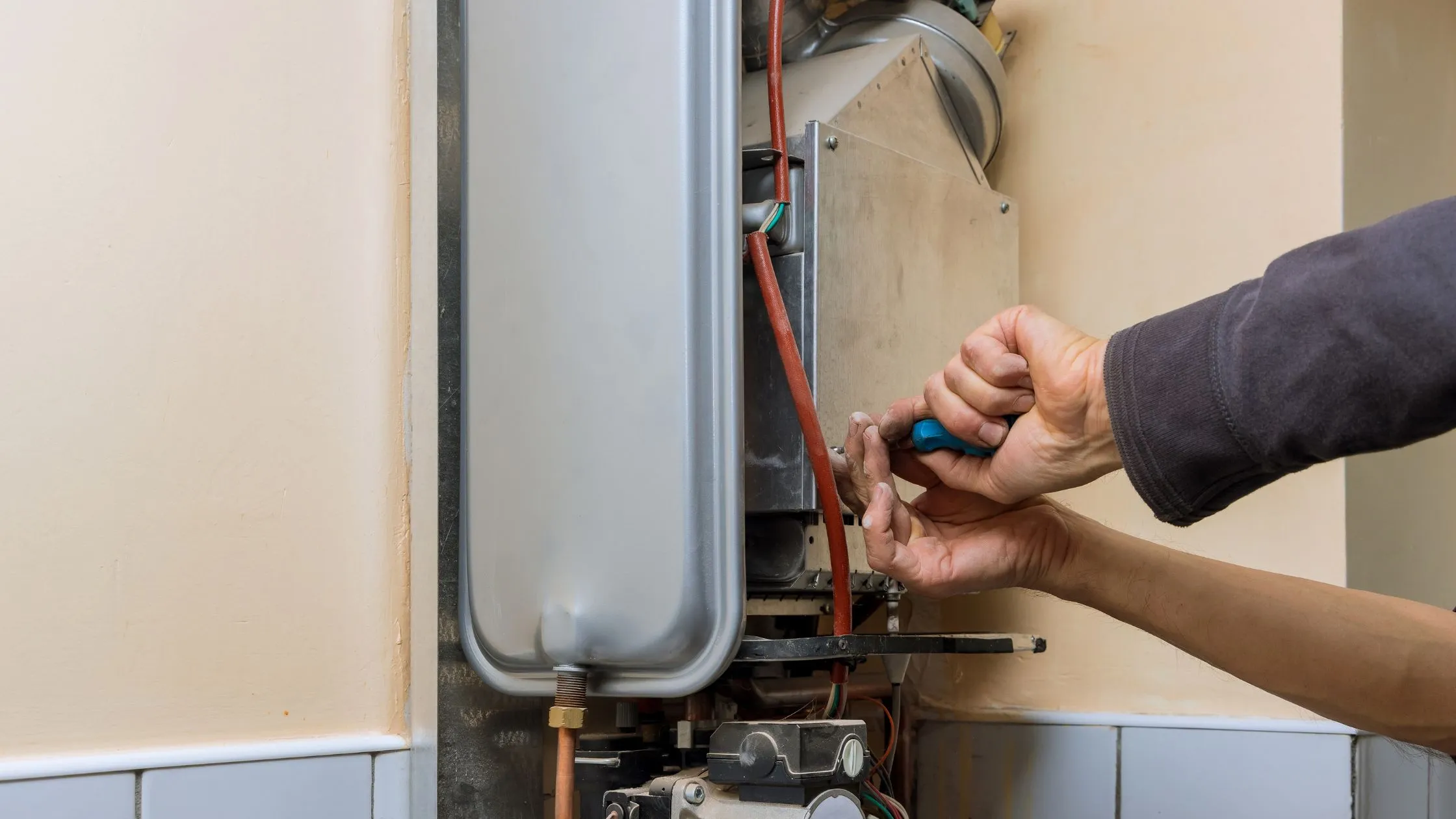


Gas Boiler Servicing in Paris: The Law and Best Timing

Yes, annual boiler servicing is mandatory in France. Decree no. 2009-649 of 9 June 2009 requires it once a year for gas, oil, wood and coal boilers between 4 and 400 kW, which covers almost every home. Tenants normally pay for it, and the engineer must give you an attestation d'entretien (service certificate) to keep.
If your boiler has already broken down, start with our guide heating breakdown in Paris: what to do.
Need a heating engineer? Boiler repair, annual servicing and replacement across Paris and the inner suburbs: see our heating engineer service in Paris.
Every autumn the same question comes back: do I really need to have my boiler serviced? The answer is yes, and not only to avoid being cold. It is a legal requirement, a safety issue, and one of the most worthwhile bits of upkeep in any home.
The subject is still confusing, especially if you are new to France. Between the "special offer" flyers taped up in building entrances, maintenance contracts that are hard to read, and pushy cold calls, it is hard to know who to trust. This guide covers it all: what the law says, who pays for what, what the engineer actually checks, and when in the year to book.
What the law says
Annual servicing is not optional. Decree no. 2009-649 of 9 June 2009 makes it compulsory for every boiler with an output between 4 and 400 kilowatts, which covers nearly all domestic installations.
It applies to boilers running on natural gas or propane, oil, wood and coal. Electric boilers are not covered, although a check every two to three years is still recommended. Heat pumps fall under a separate regime, with a compulsory leak check depending on the amount of refrigerant they contain.
Frequency: at least once a year.
Tenant or landlord: who pays?
This is a frequent source of disputes between tenants and landlords, yet the rule is simple.
The tenant pays for routine annual servicing: it counts as a tenant's charge ("charge locative") unless the lease explicitly says otherwise. The tenant must be able to show the certificate to the landlord or to the insurer.
The owner pays for servicing if they live in the property. If they rent it out, they remain responsible for major repairs and for replacing a boiler that has reached the end of its life, unless the tenant is shown to have neglected the servicing, which changes everything in a dispute.
In a building with shared heating, the syndic (the building's managing agent) arranges servicing of the central boiler room, and the cost goes into the service charges. Be careful, though: if you have your own gas water heater or an individual top-up heater, servicing it is still your responsibility. If your flat is cold while the central boiler is working, our article on inadequate shared heating explains your options.
One point often overlooked: a landlord cannot force a tenant to use a particular heating engineer. They can recommend one, not impose one, as long as the professional the tenant chooses is qualified.
What you risk without servicing
The administrative fine can reach 1,500 €, but it is rarely applied. The real risk lies elsewhere.
Your home insurer may refuse to pay out. After a fire, an explosion, carbon monoxide poisoning or water damage coming from the boiler, the insurer will ask for the attestation d'entretien. Without it, a refusal is possible, and the damage can run to tens of thousands of euros.
You can be held liable if an incident affects your neighbours and the servicing had not been done. In a Paris apartment building, that is far from theoretical.
Your manufacturer's warranty can lapse. On a new boiler, the warranty almost always depends on annual servicing.
Why it really matters
Carbon monoxide
Carbon monoxide (CO) is an invisible, odourless and deadly gas produced by poor combustion. In France there are 3,000 to 4,000 cases of poisoning and around a hundred deaths a year; it is the leading cause of death by toxic gas in the country.
The symptoms are misleading: persistent headaches, nausea, dizziness, confusion. They look like flu, which is exactly what makes them dangerous. The warning sign is that several people in the home feel them at the same time.
In Paris, the buildings add to the risk: small flats, sealed-up windows, blocked mechanical ventilation (VMC), low air vents hidden behind furniture. Checking the CO level and the supply of combustion air is the engineer's first job, before any cleaning.
If you see an orange or yellow flame instead of a blue one, soot around the boiler, or a lingering smell, switch the boiler off and call straight away. If you smell gas, follow the emergency procedure: windows open, no switches, gas off at the meter, then call GRDF on 0 800 47 33 33.
Lower bills
A poorly maintained boiler uses more energy than it should, for four reasons: a dirty burner, scale in the heat exchanger, settings that have drifted, and small leaks that go unnoticed.
Servicing restores efficiency by 8 to 12 %, a saving that shows up on every gas or oil bill for the rest of the year.
A longer life
A boiler serviced every year lasts 15 to 20 years. Without servicing, expect 10 to 12. That is five to eight extra years, because parts wear less, small faults are caught before they get worse, and corrosion and scale are kept in check.
The sums are simple: years of servicing cost less than the early replacement they help you avoid. If your boiler is approaching fifteen years and breaking down more often, the question changes. Our article on when to replace your boiler compares repair and replacement.
What a proper service includes
A real service takes an hour to an hour and a half. Not ten minutes. The decree sets out eight compulsory operations:
- Cleaning the heat cell: removing soot and combustion residue that clog the burner and the heat exchanger.
- Checking and adjusting the burner: the flame should be blue and steady; a yellow or orange flame means incomplete combustion.
- Measuring the carbon monoxide level: the acceptable threshold is below 10 ppm.
- Checking the flue: unobstructed, sealed, with enough draught.
- Checking the safety devices: relief valve, thermostat, flame detector, gas pressure.
- Checking the gas or oil circuit for leaks: finding even the smallest leaks.
- Advice on use: settings suited to your home and your routine.
- Handing over the attestation d'entretien.
On top of these, we carry out further checks as standard: the circulation pump, the expansion vessel, the circuit pressure (between 1 and 1.5 bar), cleaning or replacing filters, and a full flue gas analysis that allows fine adjustment.
Descaling the heat exchanger deserves a separate mention. Paris water measures 20 to 30 °f (French degrees of hardness): hard water that scales quickly. Descaling every three to five years is recommended, and some contracts include it.
The attestation d'entretien: do not lose it
At the end of the visit, the engineer gives you an attestation d'entretien, the service certificate. We provide it in digital form, precisely so it does not get lost.
Keep it for at least two years with your important papers, and keep a copy in the cloud. It is the document your insurer will ask for after a claim.
Tenants: when you leave, give the landlord a copy of all your certificates. It proves you met your obligation and avoids arguments over the deposit.
The best time: September to October
The law sets an annual frequency but leaves the date to you. That choice has real consequences.
The ideal window runs from June to October, with September the best month. Four reasons:
You get an appointment quickly. Outside the heating season, diaries are open. In November and December, emergency call-outs fill every Paris heating engineer's schedule and waiting times grow.
You do not feel the shutdown. Servicing means switching the heating off for 30 to 60 minutes. In September that makes no difference to your comfort. In January it does.
You have time to repair. If the engineer spots a worn part, you can get a quote, compare and plan. In the middle of a cold snap, you are under pressure and pay for the urgency.
Your boiler goes into winter in good shape, instead of going back to full power after months of rest. That restart is exactly when built-up weaknesses show, and the most common cause of early-season heating breakdowns.
Can it be done in winter? Yes, and a service in December is far better than none at all. Just expect longer waits and an uncomfortable spell without heating.
If you have missed the date, book as soon as you think of it; do not wait for next year. A margin of about a month either side of the anniversary date is generally accepted.
Our plumbing checklist before winter brings together all the start-of-season checks, servicing included.
What it costs
The price of a service depends on the type of boiler, how easy it is to reach and whether you take a maintenance contract. Ask for the price before the visit is booked. What is certain is what to be wary of.
A rock-bottom "from" price is not a real service. A proper visit takes an hour to an hour and a half. At a giveaway price, either the visit is rushed through in ten minutes or it is a pretext to sell you a new boiler.
Be wary of cold calls. Phone calls and texts announcing that "your boiler urgently needs servicing" come from companies that know nothing about your boiler or your home.
We never replace a part without an approved quote. If the engineer finds a worn thermocouple or ignition electrode, they explain why and give you the price on the spot. Details of our services are on our prices page.
One-off visit or maintenance contract?
A one-off visit: you call each year, you keep track of the date, you pay per visit. Simple, but the follow-up is up to you.
A maintenance contract: we remind you automatically, the appointment is scheduled, and you do not forget. It includes the annual visit and call-outs for breakdowns during the year. It is the option we recommend for boilers more than five years old, where the likelihood of a breakdown justifies the cover.
Read the terms before signing, with us as with anyone: some contracts on the market include a limited number of call-outs, others only a discount on parts.
Choosing a heating engineer in Paris
Check their qualifications
Work on gas boilers and heat pumps requires specific qualifications, and work that qualifies for French energy-renovation grants must be done by a contractor holding the right label. Ask the company which qualifications it holds and ask to see the paperwork before any work starts: a serious professional shows it without hesitation. Ask for proof of their building insurance (the "assurance décennale") too. Our guide to the certifications to check explains each label and how to verify it.
Other things to look at
Verified customer reviews and a real track record. Be wary of a company with no online presence, or whose reviews all date from the same month.
Local roots. If your boiler breaks down on a January evening, you want a tradesperson who knows your neighbourhood, your type of building and its access constraints, not a call centre far away.
If you are unsure whether you need a plumber or a heating engineer, our article on the difference between the two trades explains who does what.
Paris specifics
Shared flues. In Haussmann-era buildings, flues are shared and sweeping them (compulsory twice a year) is the building's responsibility. Check that it is done: a dirty flue directly affects how your boiler runs.
Boilers on the roof or in the cellar. Common in Paris, they make access harder. Tell the engineer in advance: a ladder or the key to a storage room may be needed, and the visit may take longer.
Poor ventilation. Older flats are often badly ventilated. The low air vent is compulsory and must never be blocked: it supplies the air the boiler needs to burn gas safely.
Hard water. At 20 to 30 °f, it scales the heat exchanger faster than elsewhere. Beyond periodic descaling, a water softener or an anti-scale treatment on the closed heating circuit limits the problem over the long term.
When not to wait for the annual visit
Call someone out straight away if you notice:
- an orange or yellow flame instead of a blue one: poor combustion, producing CO;
- a lingering smell of gas: switch off, air the room, get out, call GRDF;
- smoke or soot around the boiler;
- unusual noises: banging, whistling, rumbling;
- energy use that has jumped for no reason;
- repeated breakdowns or regular safety lockouts;
- pressure that drops and has to be topped up often;
- radiators that heat poorly while the boiler is running: see our guide to bleeding and flushing radiators.
Frequently asked questions
Is servicing compulsory for an electric boiler? No. It is still recommended every two to three years to keep consumption down and catch a scaled heating element or a faulty thermostat.
Can I service my boiler myself? No, it is not allowed. Only a qualified professional can carry out the service and issue the attestation d'entretien. Working on a gas appliance without the right qualification is dangerous.
Should I switch my boiler off in summer? No. Put it on "summer" mode (hot water only). Switching it off completely can cause the circulation pump to seize.
My boiler makes a bubbling noise. Is that serious? It is often scale or air in the circuit. Bleeding the radiators may be enough; if the noise continues, professional descaling is needed.
What happens if I skip a year? Book as soon as you notice. Every year without servicing increases the risk of breakdown, higher bills and poisoning, and if you make an insurance claim in the meantime, the insurer may refuse to pay out.
Does servicing cover repairs? No. Servicing is preventive. If a part has failed, the repair is charged separately, always after a quote.
Condensing boiler or conventional boiler? Condensing boilers are now the standard for any replacement: more expensive to buy, they save 20 to 30 % on energy.
Book before the cold
Do not wait for the first cold snap to think about your boiler: that is when diaries fill up and waiting times grow.
Réseau Tubulure works in Paris and the inner suburbs: Paris (75), Hauts-de-Seine (92), Seine-Saint-Denis (93) and Val-de-Marne (94) (see our service area), on all the major brands: Vaillant, Bosch, Viessmann, Saunier Duval.
Full service in line with the decree · Attestation d'entretien handed over on the day · Quote before any repair · Maintenance contracts available
We take calls 7 days a week, 24 hours a day, for servicing as well as breakdowns. Many of our plumbers speak English. If the heating has already stopped, see our guide heating breakdown in Paris: what to do.
01 89 70 15 36 (from abroad: +33 1 89 70 15 36). Book a visit · See our prices · Heating emergency