



Boiler noises: jet-engine roar, banging and whistling
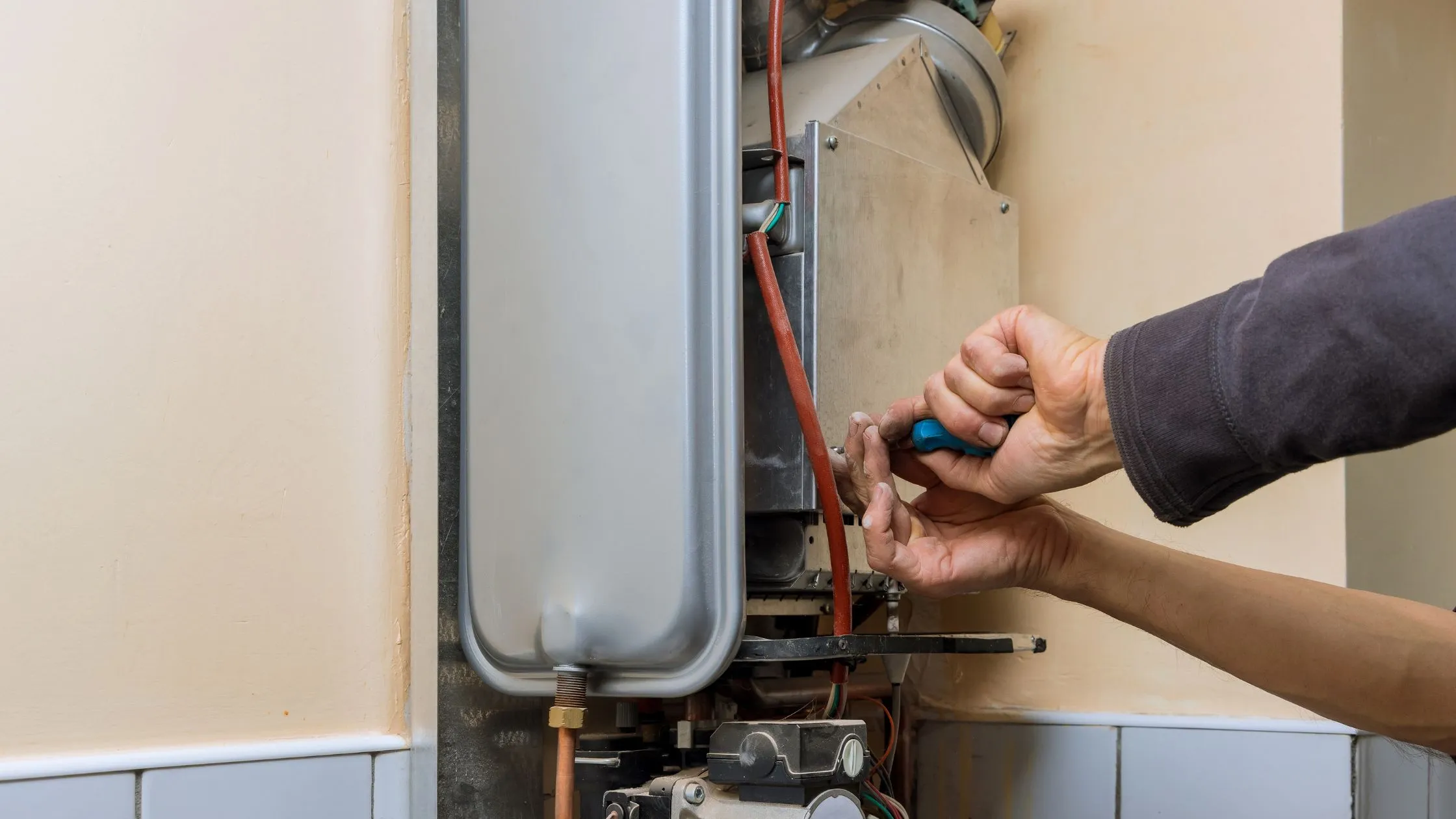
A jet-engine noise usually comes from the flue fan or from badly tuned combustion. Banging comes from expansion or restricted water flow, and whistling or bubbling from air in the circuit or limescale in the heat exchanger. If the noise comes with a smell or headaches, switch the boiler off.
For an on-site diagnosis, see our heating engineers in Paris.
Safety first: noise plus smell, soot or feeling unwell
A noise on its own is not an emergency. It becomes one if it comes with a smell of gas, soot marks around the boiler, a yellow flame instead of a blue one, or headaches in several people. In that case, switch the boiler off, air the room, go outside, and call GRDF's Urgence Sécurité Gaz line on 0 800 47 33 33 (free, 24 hours a day) for a gas smell, or 15, 18 or 112 if anyone feels unwell. Full steps are in our article on what to do if you smell gas.
Some recent boilers monitor their own combustion. Saunier Duval's ThemaPlus Condens, for example, has a safety shutdown when carbon monoxide exceeds a threshold (code F.56). If that code appears, do not keep resetting the boiler.
The best clue: when the noise happens
When the noise occurs often tells you which part is involved. Watch before you call:
- At ignition (a sudden whoosh, a small "boom", a bang): ignition or combustion. The Saunier Duval manual notes that a gas type that does not match the boiler's setting can make it noisy at ignition or during combustion, and lists a blocked condensate pipe among the causes of ignition failure (codes F.28 and F.29).
- A loud, steady rush throughout heating, the jet-engine noise: the flue fan, or a circulation pump set too high.
- A kettle-like bubbling while heating: water is not flowing well and boils in spots inside the heat exchanger, because of air, sludge or a tired pump.
- Only when you run hot water: the domestic hot water side, most often a scaled heat exchanger.
- Sharp clicks at the end of heating or while cooling: pipes and radiators expanding and contracting.
- A thud in the pipes when a tap closes: water hammer, which does not come from the boiler. See our article on water hammer.
If you can, film twenty seconds of the noise with sound and note any code on the display. A heating engineer quickly recognises a fan bearing or boiling water.
My boiler sounds like a jet engine
On a room-sealed or condensing boiler, a fan draws in air and pushes the flue gases outside. As its bearing wears, it whines and then roars, louder week after week. When the flue or terminal is partly blocked, it strains. The Saunier Duval manual links its fan fault code (F.32) to a possible obstruction of the fan or the flue gas path.
The other source is combustion itself: a dirty burner or a badly set air and gas mix rumbles. The setting is checked during servicing: the manufacturer schedules a CO2 check every year. A jet-engine noise that starts soon after a repair is worth a call to the company that did it.
Banging: expansion, air or boiling water
Clicks at the end of heating are metal expanding, especially on long copper runs in older buildings, held tight in the floors. They are harmless. Banging during heating with a kettle-like sound is different: water is not moving fast enough through the heat exchanger and forms steam bubbles. The manufacturer links this kind of situation to safety shutdowns for an excessive temperature difference or a too-fast temperature rise (codes F.23 and F.24), caused by air, low water or the pump.
The manual's own first step when a noise persists after filling is to bleed the system again. For the radiators, our guide on radiators that heat poorly explains bleeding. Then check the pressure: 1 to 1.5 bar cold on most boilers, depending on your model's manual.
Whistling and bubbling: Paris limescale
A whistle that only happens when you draw hot water points to the domestic hot water heat exchanger. Tap water runs through it at every shower, and limescale builds up. In Paris, the 588 public hardness measurements taken by the health authorities' water monitoring between 1 July 2025 and 30 June 2026 give a median of 26.2 °f (French degrees of hardness), with eight in ten between 23.8 and 29.7 °f: clearly hard, limescale-prone water. The radiator circuit is closed and mainly scales up when fresh water is added often.
Be wary of "anti-noise" or descaling products poured into the circuit: the Saunier Duval manual warns that unsuitable additives can themselves cause noise in heating mode and damage components.
What not to do
- Open the cover to find the source of the noise.
- Keep resetting the boiler when a safety code comes back.
- Add a product to the circuit without professional advice.
- Ignore a new noise that comes with a smell or soot.
When to call a heating engineer
- The jet-engine noise gets louder week by week.
- Banging or bubbling happens during heating, not only while cooling.
- A fault code comes with the noise.
- The noise started just after a repair.
Diagnosis and repair are quoted, with the price given before any work; the call-out charge inside Paris is 90 euros excluding VAT. See our prices page. If this year's annual service has not been done, it is often the moment to deal with the noise: our article on gas boiler servicing in Paris explains what it includes.
Frequently asked questions
My boiler sounds like a jet engine. Is it dangerous?
Usually not right away: it is a worn fan or badly tuned combustion. But badly tuned combustion can produce carbon monoxide. If the noise comes with a smell, soot, a yellow flame or headaches, switch the boiler off, air the room and go outside.
Why does my boiler bang or click?
Clicks at the end of a heating cycle or while cooling are usually pipes and radiators expanding and contracting, which is harmless. A loud bang at ignition is a combustion issue and needs checking. Repeated banging while heating can mean water is boiling in spots inside the heat exchanger.
My boiler whistles when I run the hot tap. Why?
A whistle that only happens when you draw hot water comes from the domestic hot water side, often a scaled heat exchanger restricting the flow. Paris water is fairly hard, around 26 °f median over a year of public measurements. Descaling or replacing the exchanger solves it.
Is the noise coming from the boiler or the radiators?
Turn the heating off and open a hot tap: if the noise continues, it is the boiler's hot water side. Then run the heating with the taps closed: a noise located in one radiator or pipe is more likely air, a valve closed too far, or expansion.
Will the annual service get rid of the noise?
Often, when the noise comes from combustion or dirt: the service includes cleaning the combustion chamber and checking the settings. A worn fan or a scaled heat exchanger needs a separate, quoted repair.
In short
To identify a boiler noise, note when it happens: at ignition, during heating, when you draw hot water or while cooling. A jet-engine noise mostly comes from the fan or combustion, bubbling from restricted flow, a whistle at the hot tap from a scaled heat exchanger, and end-of-cycle clicks from expansion. Bleeding and checking the pressure are things you can do; the rest is for a heating engineer. Smell, soot or feeling unwell: switch everything off and get out.
Noisy boiler in Paris? We will come and listen
Send us a short video of the noise and a photo of the display, and we will tell you whether it can wait until the service. Fast response 7 days a week, 24 hours a day, with priority for emergencies. Réseau Tubulure works across Paris and the inner suburbs (92, 93, 94). Many of our plumbers speak English.
- Phone: +33 1 89 70 15 36
- Form: contact us
- WhatsApp: use the button on the site
Sources: Saunier Duval ThemaPlus Condens installation and maintenance manual (0020238207_08), fault code and maintenance tables; Hub'Eau, drinking water quality API, water hardness in Paris, measurements from 1 July 2025 to 30 June 2026; GRDF, Urgence Sécurité Gaz. Accessed 27 October 2026.


