

Summer Insulation in a Haussmannian Apartment: Where to Start

Haussmannian apartments are the charm of Paris — high ceilings, mouldings, large windows. But in summer, these same features become thermal liabilities. On the top floor under zinc rooftops, in a south-facing living room with large windows, the temperature can climb well above 30 °C with no way to bring it back down. Improving summer insulation in these older homes is possible, if you target the right weak points.
Why Haussmannian Buildings Suffer in Summer
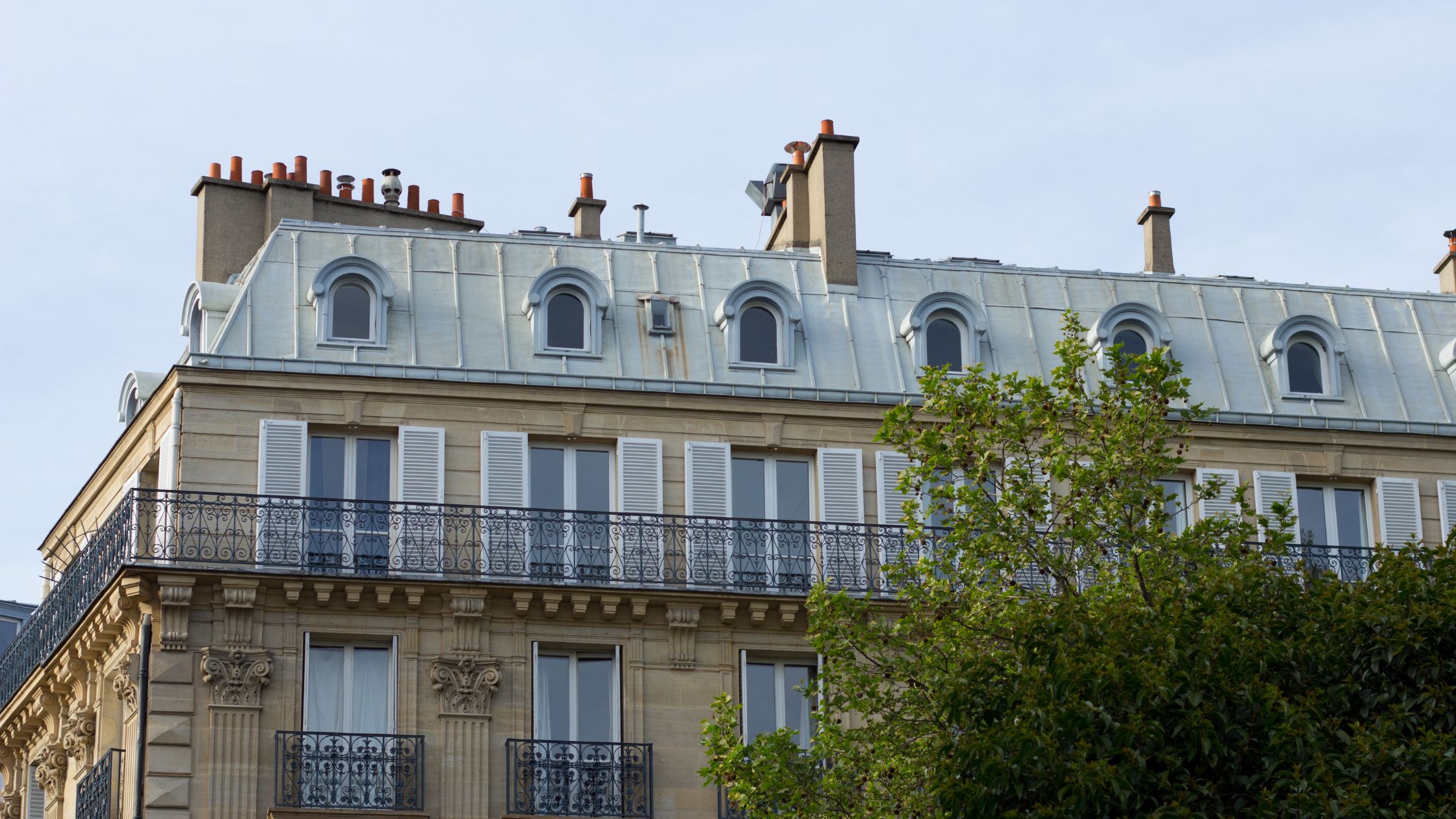
Haussmannian buildings, designed in the 19th century, were never intended to withstand heatwaves. Several structural elements explain the overheating:
– Large windows: a brightness asset in winter, they become massive solar radiation entry points in summer — especially in single glazing, still common in older building stock
– Top floor under zinc roofing: zinc reaches 60–70 °C in direct sunlight and transmits this heat directly to the ceiling. The often uninsulated attic space acts like an oven
– Limestone walls: their high thermal inertia is an advantage in winter (they release heat slowly) but a problem in summer when the heatwave lasts — once the walls are "loaded," they radiate heat for days
– High ceilings (often 2.80 m to 3.20 m): hot air rises and stagnates in the upper part, creating a hot layer that is difficult to evacuate without a ceiling fan
– No shutters on some facades: many Haussmannian buildings, particularly in central arrondissements, have no shutters on the street side — for aesthetic or heritage reasons
Priority Weak Points to Address
1. The Roof and Attic
This is the most impactful area. An uninsulated attic under zinc roofing can add 5 to 8 °C to the top-floor apartment. Solutions:
– Under-rafter insulation with rock wool or cellulose wadding (if the attic is accessible)
– External insulation (sarking) during roof replacement — more costly but effective for both summer and winter
– Reflective screen under roofing: a thin film placed under the zinc reflects part of the infrared radiation
2. Windows
Single glazing lets through approximately twice as much radiant heat as high-performance double glazing. Options:
– Replacement with low-emissivity double glazing (the most effective, but costly and subject to authorisation in protected areas)
– Interior secondary glazing: adding a second pane on the inside, without touching the existing frame — a compromise for heritage constraints
– Reflective solar film: reduces gain by 30–50% without works, a reversible solution. Check compatibility with existing glazing
3. Walls
Internal wall insulation is feasible but costs living space — a problem in Parisian apartments where every square metre counts. External insulation is generally impossible on a listed Haussmannian building or in a conservation area (the facade cannot be modified).
Alternative: thin insulating renders (2–3 cm) provide a moderate gain without significant loss of floor area.
Solutions Compatible with Historic Buildings
The challenge in Haussmannian buildings is to respect the building's character while improving summer comfort:
– Appropriate exterior sun protection: discreet awnings, interior shutters (louvres), or solar films — solutions that do not alter the facade appearance or are reversible
– Ceiling fan: ideal with Haussmannian ceiling height (2.80 m+). Perceived cooling effect of 4–6 °C, negligible consumption
– Optimised night ventilation: cross-ventilated apartments (street + courtyard) can create very effective natural draught. Installing ventilation grilles in interior doors to facilitate circulation even with doors closed
– Reflective roofing paint (cool roof): if the co-ownership renovates the roof, a high-reflectance paint on the zinc can reduce solar absorption by 30–40%
Co-Ownership and Heritage Constraints
Any insulation project in a Haussmannian building must take two frameworks into account:
Co-ownership: works affecting common parts (roof, facade, street-side windows) require a general assembly decision. It is better to carry the project collectively — a co-ownership energy audit (mandatory since 2024 for buildings with more than 50 units) can provide the technical arguments.
Heritage: in protected areas (Le Marais conservation area, ABF perimeter around historic monuments, PSMV), facade modifications are regulated. Window replacement, installation of shutters or exterior blinds must be approved by the Architecte des Bâtiments de France. Interior solutions (secondary glazing, film, ceiling fan) are exempt from these constraints.
Available Financial Assistance
Several schemes fund thermal insulation, for both summer and winter:
– MaPrimeRénov': available to owner-occupiers and landlords for attic, roof, wall, and window insulation
– Energy Savings Certificates (CEE): bonuses paid by energy suppliers for insulation works
– Interest-free eco-loan: interest-free financing for renovation work packages
– Co-ownership funds: some co-ownerships provision a works fund that can co-finance collective insulation
Insulation is an investment that improves comfort in both summer AND winter — every euro spent works in both directions.
Réseau Tubulure works on the thermal comfort of Parisian apartments. If insulation is not enough, we can assess with you the installation of air conditioning suited to your Haussmannian home. Contact us for a free assessment.
Frequently Asked Questions
Does insulation protect from heat as much as from cold?
Yes, the principle is the same: a well-insulated wall slows down heat transfer in both directions. In winter, it prevents heat from escaping; in summer, it prevents outside heat from entering. Attic insulation is particularly effective in summer because the roof is where solar gain is greatest.
Can you change windows in a protected area?
It is possible, but with conditions. In a conservation area or within an ABF perimeter, replacing street-side windows requires approval from the Architecte des Bâtiments de France. The frames must generally replicate the original appearance (profile, colour, material). On the courtyard side, constraints are generally more relaxed. Interior secondary glazing is an alternative that does not alter the exterior appearance.
Is the top floor really the hottest?
In a Haussmannian building, the top floor is almost always the most exposed to summer heat. The zinc roof massively absorbs solar radiation and transmits it to the ceiling. The difference from intermediate floors can reach 3 to 6 °C on heatwave days. Insulating the attic is the most cost-effective measure for top-floor occupants.
Contact Réseau Tubulure
Need a plumber or air conditioning specialist in Paris? Réseau Tubulure responds quickly throughout Paris and Île-de-France.