

Reversible Air Conditioning: The 2-in-1 That Cools in Summer and Heats in Winter
Cooling your apartment during a heatwave and heating it during the transitional seasons with a single appliance: that is the principle of reversible air conditioning. Also known as an air-to-air heat pump, this solution is attracting more and more Parisians looking for versatility and savings. But how does it actually work, what are its real-world performance levels and what precautions should be taken in an apartment building? Here is a comprehensive overview.
How reversible air conditioning works
Reversible air conditioning is based on the air-to-air heat pump (HP) principle. A refrigerant circulates in a closed loop between an outdoor unit and one or more indoor units, changing state (liquid/gas) to transfer heat from one side to the other.
In cooling mode (summer)
The indoor unit captures the heat present in the room's air and transfers it, via the refrigerant, to the outdoor unit which expels it outside. The indoor air is thus gradually cooled.
In heating mode (winter)
The cycle reverses. The outdoor unit draws heat from the outside air — even at low temperatures — and transfers it indoors. The appliance then functions as a fully-fledged heater.
This heat transfer mechanism, rather than direct heat generation, explains the high efficiency of these appliances: for every 1 kWh of electricity consumed, a reversible air conditioner delivers an average of 3 to 4 kWh of heat (or cooling). This ratio is expressed by the coefficient of performance (COP) in heating mode and the energy efficiency ratio (EER) in cooling mode.
The benefit of 2-in-1: one appliance, two seasons
Simplicity and space saving
Rather than installing a supplementary heating system and a separate air conditioner, reversible air conditioning combines both functions in a single piece of equipment. In a Parisian apartment, where every square metre counts, this compactness is a real asset.
Savings on your energy bill
With a COP of 3 to 4 in heating mode, reversible air conditioning consumes two to three times less electricity than a standard electric radiator (convector or radiant panel) to produce the same amount of heat. Over a heating season, the savings can reach 30 to 50% compared to direct electric heating.
Year-round comfort
The appliance provides continuous thermal comfort:
– In summer, it maintains a pleasant indoor temperature even during peak heat.
– During transitional seasons (October–November, March–April), it takes over when the apartment building's collective heating is not yet running or has been switched off.
– In winter, it can serve as the main heating system in well-insulated homes or as an effective supplement in other cases.
Air filtration
Most indoor units include filters that trap dust, pollen and fine particles. A significant advantage in Paris, where outdoor air quality is regularly poor.
Performance and limitations: what you need to know
Heating mode performance
Reversible air conditioning operates effectively down to outdoor temperatures of -10 to -15°C depending on the model. In Paris, where temperatures rarely drop below -5°C, this is generally not an issue.
However, the COP decreases as the outdoor temperature drops:
– At 7°C outdoor: COP of 3.5 to 4.5 (excellent efficiency).
– At 0°C outdoor: COP of 2.5 to 3 (good efficiency).
– At -7°C outdoor: COP of 1.5 to 2 (moderate efficiency, close to an electric radiator).
In practice, in Paris, reversible air conditioning delivers satisfactory efficiency throughout virtually the entire heating season.
Limitations to be aware of
– Heating comfort: the heat delivered by a wall-mounted split is blown by convection. Some users find it less pleasant than the radiant heat of a traditional radiator. Recent models with gentle diffusion and presence sensors have significantly improved on this point.
– Primary or supplementary heating? In a well-insulated apartment (EPC rating C or better), reversible air conditioning can cover all heating needs. In a poorly insulated older property (EPC E, F or G), it is more relevant as a supplement to existing heating.
– Noise: modern indoor units operate at a noise level of 19 to 25 dB(A) in night mode, comparable to a whisper. The outdoor unit, however, must be factored in for the neighbours.
In apartments and Parisian apartment buildings
Installing reversible air conditioning in a Parisian apartment building involves specific steps, distinct from those for a detached house.
Apartment building authorisation
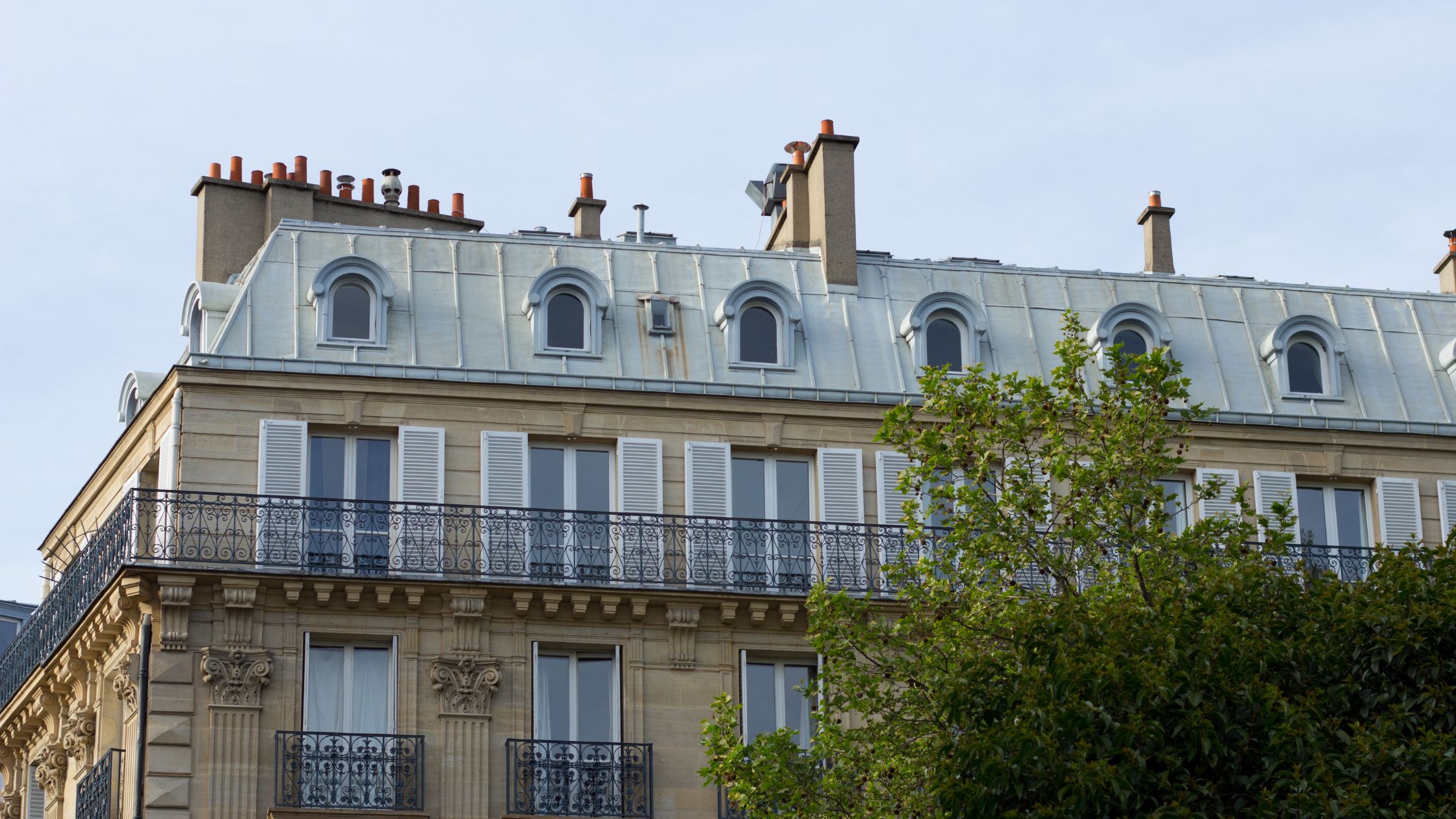
The outdoor unit must be mounted on the facade, on a balcony, in the courtyard or on the roof terrace. In all cases, it modifies the external appearance of the building and requires a vote at the general assembly of co-owners (Article 25 majority of the French law of 10 July 1965).
Protected facade constraints
Many Parisian buildings are located in ABF (Architect of Historic Buildings) zones or within the perimeter of a listed monument. Installation may then require:
– Mounting in the courtyard rather than on the street-facing facade.
– A discreet enclosure for the outdoor unit (housing, grille).
– A prior works declaration at the town hall.
Choosing the location
The location of the outdoor unit determines both the appliance's performance and the neighbours' peace and quiet. A qualified professional will be able to identify the optimal position, taking into account regulatory distances, noise nuisance and the building's aesthetics.
For a detailed guide on steps, prices and available subsidies for installation in a Parisian apartment, see our dedicated article: Complete guide to reversible air conditioning installation in Paris.
Cost and maintenance: the essentials
Indicative price ranges
The cost of installing reversible air conditioning in a Parisian apartment varies depending on the power output, the number of indoor units and the complexity of the installation:
– Single split (1 indoor unit): 1,800 to 3,500 euros including VAT, installed.
– Multi-split (2 to 4 indoor units): 4,000 to 8,000 euros including VAT, installed.
These ranges include supply, commissioning and compliance. Prices may vary depending on the property's accessibility, the length of refrigerant lines and any apartment building constraints.
Mandatory maintenance
Since 1 July 2020, any air conditioning equipment containing more than 2 kg of refrigerant (i.e., the vast majority of residential installations) must undergo mandatory maintenance every two years by a qualified professional. This maintenance includes:
– Leak testing of the refrigerant circuit.
– Cleaning the filters and heat exchangers.
– Checking energy performance.
– Inspecting electrical connections.
Between professional services, regular cleaning of the indoor unit filters (every 2 weeks during intensive use) helps maintain air quality and the appliance's performance.
Réseau Tubulure operates throughout Paris for the installation, maintenance and repair of reversible air conditioning in apartments and apartment buildings. Our RGE-qualified technicians are familiar with the specific constraints of Parisian buildings. Contact us for a quote tailored to your configuration.
Frequently asked questions
Does a reversible AC really heat well in winter?
Yes, provided the appliance is correctly sized for the property. In Paris, where winter temperatures remain moderate, a reversible air conditioner delivers a COP of 2.5 to 4 depending on conditions, making it an efficient heating method. In a well-insulated apartment, it can handle all the heating. In an older property, it is an excellent supplement, particularly during the transitional seasons when the collective heating is off.
Is it cost-effective compared to electric heating?
Very much so. With an average COP of 3.5 over a Parisian heating season, reversible air conditioning consumes approximately three times less electricity than an electric convector for the same amount of heat produced. The initial investment is recouped in 3 to 6 years depending on usage and the type of electric heating replaced. The payback is even better when the appliance is also used for cooling in summer.
Does it need the same maintenance as a standard AC?
Since a reversible air conditioner is technically identical to a standard one (same refrigerant circuit, same components), the maintenance obligations are the same: a professional inspection every two years and regular filter cleaning. Maintenance is all the more important because the appliance is used in both summer and winter, which places greater demands on the mechanical components.
Contact Réseau Tubulure
Need a plumber or air conditioning specialist in Paris? Réseau Tubulure responds quickly throughout Paris and Île-de-France.