

Leak Detection Without Breaking Walls in Paris: Professional Methods
You have a damp patch on the wall. Your water bill has doubled for no obvious reason. Or your meter is spinning even though every tap is off. You know there’s a leak — but you don’t know where.
This is where it gets stressful. Because the solution that comes to mind — knocking out the wall, lifting the tiles — is also the one you’re dreading most.
The good news: that’s no longer your only option. Specialist plumbers now use equipment that locates a leak to within a few centimetres — without touching your walls, without demolishing your bathroom, without turning your apartment into a building site.
Here’s how it works.
Why a leak can stay invisible for weeks
A leak isn’t always a visible stream of water. Most of the time it occurs on a concealed pipe — inside a wall, under a slab, behind bathroom furniture — and it travels silently before reappearing somewhere else.
This gap between the source and the symptom makes detection very difficult without the right tools. A damp patch low on a wall might come from a pipe leaking a floor above. An infiltration under the tiles might originate from a fitting three metres away.
Without a professional method, you risk opening the wall in the wrong place. And finding nothing.
The most common causes of an invisible leak in Paris:
- A worn or loose joint on a concealed pipe
- A cracked flexible hose behind a built-in unit or bath
- A micro-crack in a copper or PEX pipe under a concrete slab
- A seal failure on a flush-to-floor shower drain
- A shared riser pipe leaking between two apartments
In older Paris buildings — many built before the 1970s — lead and cast-iron pipes are particularly prone to this type of failure.
The 3 professional methods for detecting a leak without destruction
A trained leak detection plumber doesn’t start by drilling. They start by listening, observing and measuring. Here are the three main tools they use.
1. Acoustic detection
C'est la méthode la plus courante pour les fuites sur canalisations sous pression.
The principle: a leak creates a vibration that travels along the pipe and through the building materials. An acoustic sensor picks up this signal. A correlator then calculates the exact position of the leak by comparing the time it takes the sound to reach two different sensors. Accuracy is typically 10 to 30 centimetres.
Non-invasive, fast, and effective on metal, PVC or PEX pipes — in apartments, basements, or buried networks.
2. Thermal imaging (infrared thermography)
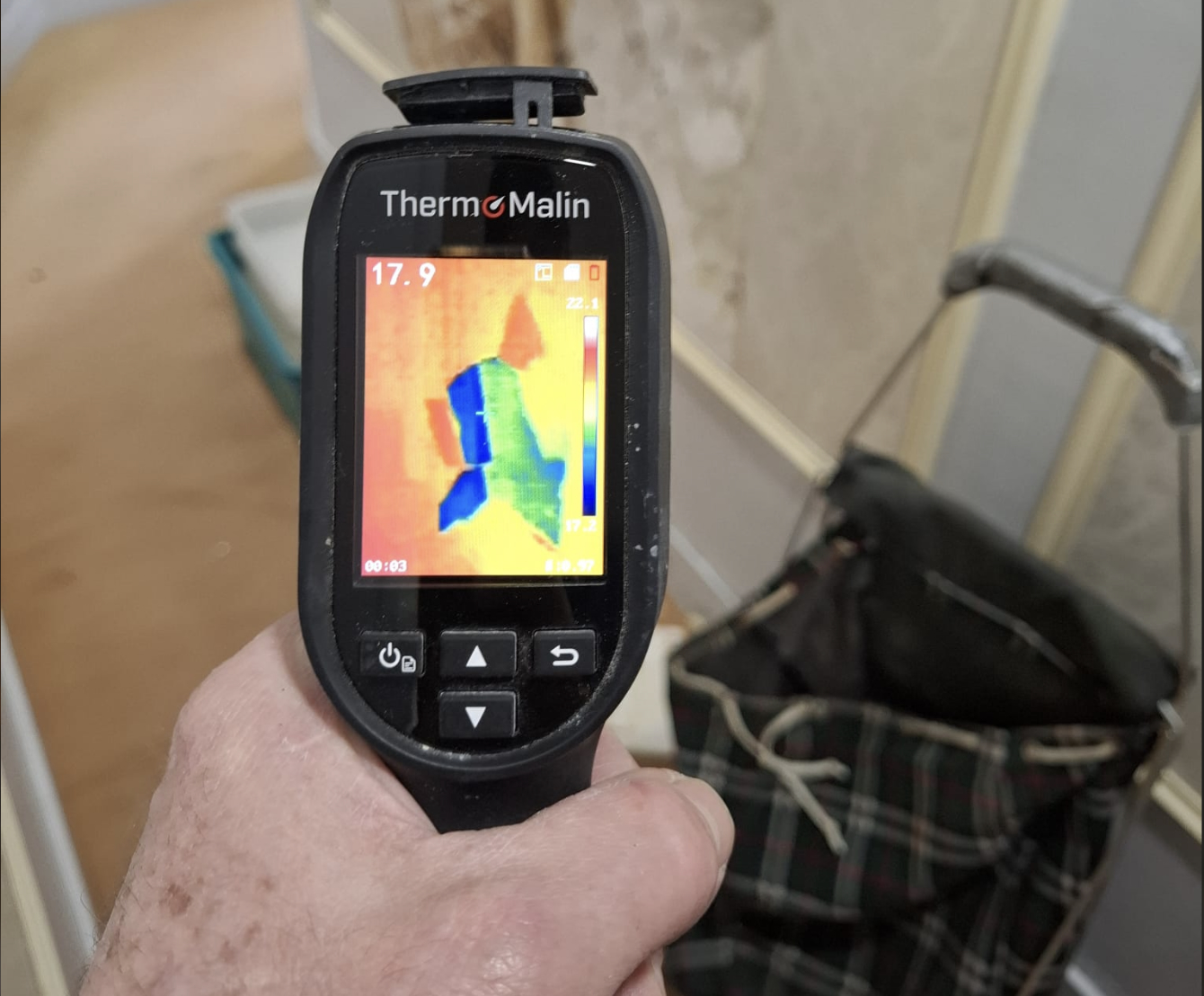
Water leaking inside a wall or under a floor changes the surface temperature of the material. A thermal camera detects these differences — even tiny ones — and translates them into a colour image where the damp zone stands out clearly.
Particularly effective for underfloor heating leaks, infiltrations behind plasterboard, or leaks in a screed layer. The technician scans the surface in minutes. No opening required.
3. Tracer gas
When the first two methods aren’t enough — very small leak, deeply buried pipe, high ambient noise — we inject a harmless gas mixture (nitrogen and hydrogen) into the pipe after isolating the network from pressure.
The gas rises through the material and escapes at the leak point. A surface detector picks it up with centimetre-level precision. This is the most accurate method for thick concrete slabs or basement pipework.
The meter test: something you can check yourself
Before calling a professional, this simple test confirms whether you have an active leak.
- Close every tap and appliance — shower, sink, toilet, washing machine, dishwasher.
- Note your water meter reading (the m³ figures).
- Wait 30 minutes without using any water.
- Read the meter again.
If the numbers have moved — or if the needle is turning slowly — you have a leak. This test doesn’t locate it, but it confirms it exists. That’s when professional intervention makes all the difference.
Why guessing and opening up is a mistake
Some non-specialist plumbers offer to ‘search by opening up’. The problem is twofold.
First, the damp patch and the source of the leak are rarely in the same place. You open, find nothing, open somewhere else. Result: multiple cuts in the walls, a damaged home, and sometimes the leak still unresolved.
Second, damage caused by a blind search isn’t covered by insurance in the same way as a documented intervention. A technical detection report — with photos and precise location — is exactly what insurers require to validate the claim.
A trained detection plumber only opens once. At the right place.
Leak detection is covered 100% by your home insurance
In the vast majority of cases, leak search and detection costs are fully covered by your French home insurance (assurance habitation), under the water damage guarantee. This includes detection costs — even when no repair is carried out at the same time.
The condition: the work must be done by a qualified professional and a technical report must be provided.
Réseau Tubulure works in direct agreement with insurers. We know the claims procedures and we compile the file for you. You call us, we detect, we write the report — you submit it to your insurer. In most cases, you don’t pay anything upfront.
How an intervention works with Réseau Tubulure
- First contact: You describe the problem. We suggest a fast appointment — often the same day.
- On-site diagnosis: The technician chooses the right detection method for your configuration.
- Precise location: The source is identified. We show you the result before touching anything.
- Technical report: With photos, precise location and recommendations — ready for your insurer or building manager.
- Repair: If the leak is accessible, we can repair it straight away.
Where we operate in Paris
We cover all Paris arrondissements and the inner suburbs: Gentilly, Arcueil, Charenton-le-Pont, Villejuif, Vanves, Les Lilas, Fontenay-sous-Bois, Montreuil, Boulogne-Billancourt and more.
Key takeaways
- The damp patch and the source of the leak are rarely in the same place
- The meter test is the first thing to check if you suspect a leak
- Leak detection is covered 100% by your French home insurance in most cases
- A technical report is essential — without it, the insurer may refuse the claim